Why Can't Anyone Tell You When Your Emergency Vehicle Will Be Ready?
Exploring why lead time predictions in custom emergency vehicle manufacturing are built on flawed assumptions, and why measuring work matters more than counting vehicles.
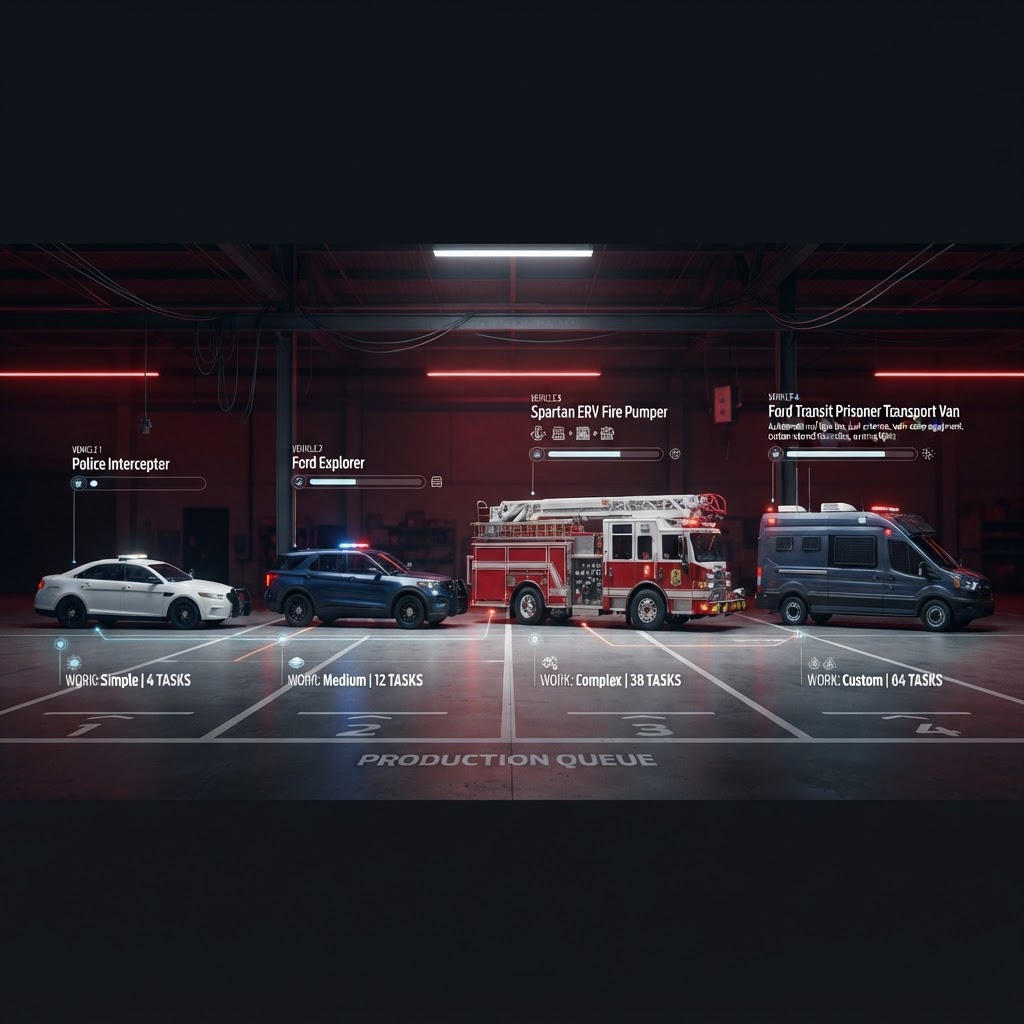
"When Will My Vehicle Be Ready?"
Nearly every fleet manager has asked that question. It's probably the most important question after signing a purchase order.
Unfortunately, it's also one of the hardest questions to answer accurately.
Not because manufacturers don't care. Not because upfitters are trying to hide something. But because the way our industry predicts lead time is fundamentally built on assumptions.
The Average
Let's use a simple example.
Suppose a shop produced:
- Week 1 = 10 vehicles
- Week 2 = 8 vehicles
- Week 3 = 12 vehicles
Average = 10 vehicles per week.
Simple.
Now here's what typically happens. A customer becomes vehicle number 41. Someone looks at production and says:
"We average ten vehicles a week. That means roughly four weeks."
Seems logical.
Except that logic assumes every vehicle represents the same amount of work.
They don't.
One vehicle might need:
- One lightbar
- A simple console
- Graphics
Another might require:
- Dual radios
- ALPR
- Radar
- Prisoner transport
- Multiple controllers
- Custom fabrication
- Additional lighting
- Specialized wiring
Those two vehicles are not equal. Yet averages treat them as if they are.
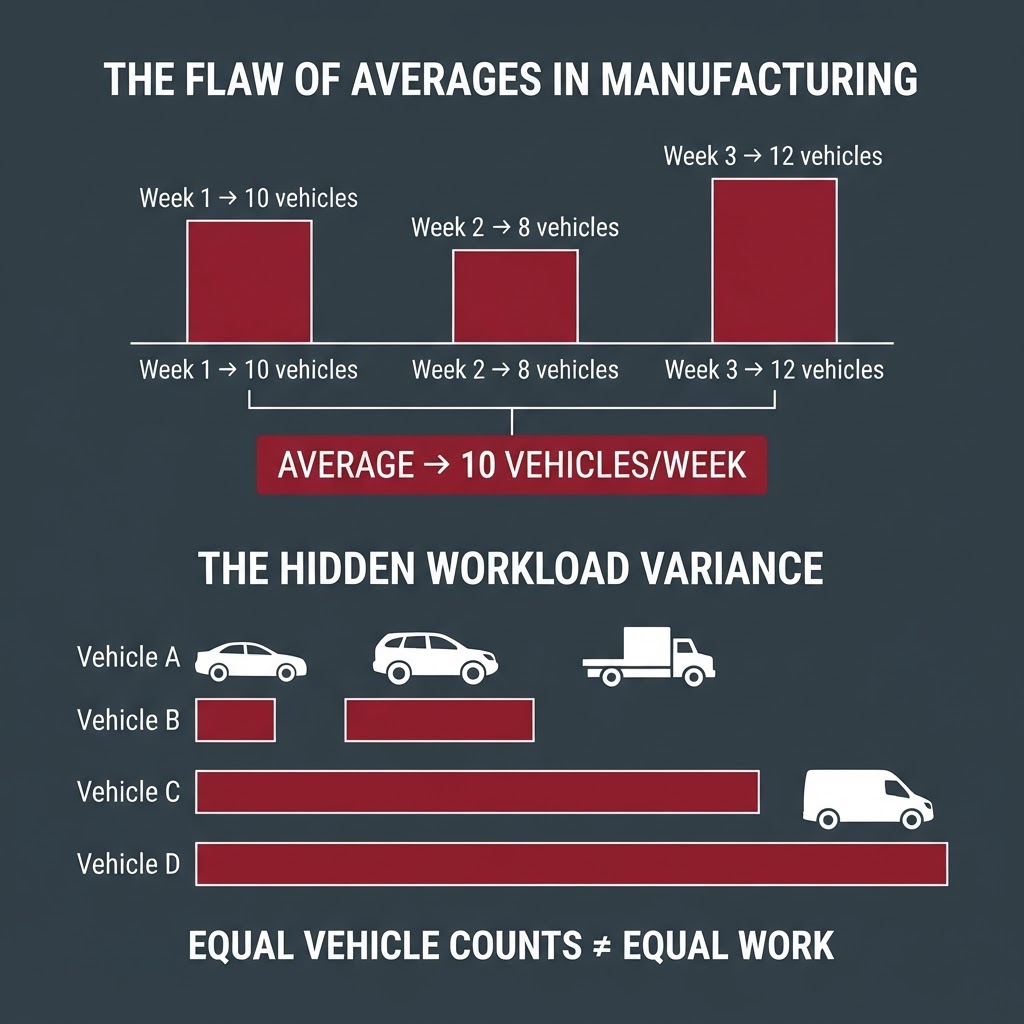 Equal vehicle counts do not equal equal work.
Dependent Events
Now let's introduce another concept: dependent events.
Imagine four vehicles moving through production:
Vehicle A → Vehicle B → Vehicle C → Vehicle D
If Vehicle A is delayed because of one missing bracket, Vehicle B starts later. Vehicle C starts later. Vehicle D starts later.
Unlike rolling dice or flipping coins, manufacturing doesn't magically "average back out." Every vehicle depends on the work completed before it. One delay becomes another. Then another. Then another.
The delay compounds throughout the schedule.
This is why customers often hear delivery dates continue to move.
Not because someone lied.
Not because someone wasn't trying.
Because the assumptions the schedule was built on changed.
Why Custom Manufacturing Is Different
Emergency vehicles aren't identical products moving down an assembly line.
Every option changes the amount of work.
Every engineering decision changes the amount of work.
Every custom request changes the amount of work.
Every interruption changes the amount of work.
If you don't understand the work...
How can you accurately understand the schedule?
Maybe We're Asking the Wrong Question
Perhaps we've been asking the wrong question all along.
Instead of asking:
"How many vehicles can we build each week?"
Maybe we should be asking:
"Exactly how much work is contained in this specific vehicle?"
Those are completely different questions.
One measures vehicles.
The other measures work.
Only one of them can accurately predict how much time a vehicle will consume.
Value Stream Thinking
The only way to truly understand lead time is to understand the work itself.
Every task.
Every dependency.
Every workstation.
Every tool.
Every piece of hardware.
Every minute.
Every capacity constraint.
Down to the nut and bolt.
Because every one of those things consumes time.
Until the work itself is understood, the schedule will always be built on assumptions.
And assumptions—especially in custom manufacturing—can become wildly inaccurate.
Why This Is So Difficult
If this sounds like an enormous amount of work...
That's because it is.
Capturing every task required to build a custom emergency vehicle is incredibly difficult.
Many people believe doing so would somehow remove customization.
We believe the opposite.
The vehicle isn't "custom" because every task is unique.
It's custom because every vehicle is made up of a different combination of tasks.
That's a very important distinction.
What if we engineered every possible task instead of treating every vehicle as one giant custom project?
What if we understood exactly how long each task actually takes?
What if we understood the proper sequence of those tasks?
What if we understood which tasks depend on others?
What if we knew how many people could realistically work on each stage at the same time without getting in each other's way?
Now we're no longer estimating a vehicle.
We're measuring the work.
It's difficult.
It requires discipline.
It requires engineering.
It requires systems.
But when it all comes together, it changes the conversation from guessing to knowing.
Because this approach is difficult, I believe it's one of the primary reasons historical averages became the industry standard.
Averages are easy.
They're quick.
They're simple to explain.
They don't require a team to understand the true scope of work before scheduling begins.
Unfortunately...
Simple doesn't always mean accurate.
And inaccurate schedules create waste throughout the entire organization.
A Direction, Not a Product
This realization is one of the ideas that eventually led us to begin developing DragonForge—specifically the engineering and planning systems behind it.
Not because we wanted to build software.
Because we wanted a better way to understand, capture, and analyze work.
Software simply became the tool that made that possible.
One advantage of building it ourselves is that every feature comes directly from the people doing the work every day.
The technicians.
The engineers.
The planners.
The people answering customer support calls.
The software isn't built by people trying to imagine our problems.
It's built by the people living them.
Today, that system allows us to capture the work itself—not just the vehicle.
Tasks.
Instructions.
Estimated time.
Required tools.
Hardware.
Dependencies.
Materials.
And much more.
Every improvement gives us another opportunity to better understand the work before production ever begins.
The Real Problem
Our industry absolutely has a lead-time problem.
I don't think anyone would argue with that.
But I also think we've accepted the industry's way of calculating lead time for so long that we've stopped questioning whether it's actually capable of producing accurate results.
If we continue using historical averages as the foundation of our schedules...
We'll continue treating inaccurate delivery dates as unavoidable.
We'll keep saying,
"That's just the way custom manufacturing works."
I don't believe it has to.
The real problem isn't lead time.
The real problem is that we're trying to predict work we haven't truly measured.
We're making educated guesses.
Some are better than others.
But at the end of the day...
They're still guesses.
Because until you know exactly what work a specific vehicle requires, exactly how long that work takes, exactly what sequence it must be performed in, exactly what resources it consumes, and exactly where capacity exists...
You're predicting based on assumptions.
Not measurements.
That realization changed the way we think.
Not because we've solved the problem.
We haven't.
We've lived it.
We've missed dates.
We've had difficult conversations with customers.
We've watched schedules move despite everyone's best efforts.
Those experiences didn't convince us that lead time couldn't be solved.
They convinced us we were measuring the wrong thing.
The better we become at measuring the work...
The better we'll become at predicting reality.
And something interesting happens as a byproduct.
When you've already engineered the work before production begins, uncertainty disappears.
Questions disappear.
Searching disappears.
Waiting decreases.
Rework is reduced.
Engineering changes become less frequent.
The vehicle doesn't just become easier to schedule.
It moves through the shop more smoothly because much of the uncertainty has already been removed before the first tool ever touches it.
That's the real opportunity.
Not simply predicting lead time more accurately.
Building a process where better lead times become the natural result of better planning.
We're investing heavily in solving that challenge because we believe our customers deserve something better than an educated guess.
Will we always be perfect?
Of course not.
Unexpected things will always happen.
But I'd rather explain a delay caused by something truly unexpected...
...than one caused by an assumption we could have measured if we'd been willing to do the work.
That's the direction we're headed.
And I believe it's a direction our entire industry will eventually have to take.
Question to Think About
The next time someone tells you they average "X" vehicles per week, ask yourself:
Are they measuring vehicles...
Or are they measuring work?
About the Author
Patrick Jiles is the Founder of Recreational Electrical.
His experience spans nearly three decades in the emergency vehicle industry and electronics. Today he leads Recreational Electrical by continually challenging assumptions about how emergency vehicles are engineered, planned, manufactured, and supported.
He doesn't claim to have all the answers.
His goal is simply to ask better questions.
GALLERY
Equal vehicle counts do not equal equal work.