It's the Way It's Always Been Done
A first entry in The DragonForge Journal — questioning the assumptions we've accepted for too long in the emergency vehicle industry.
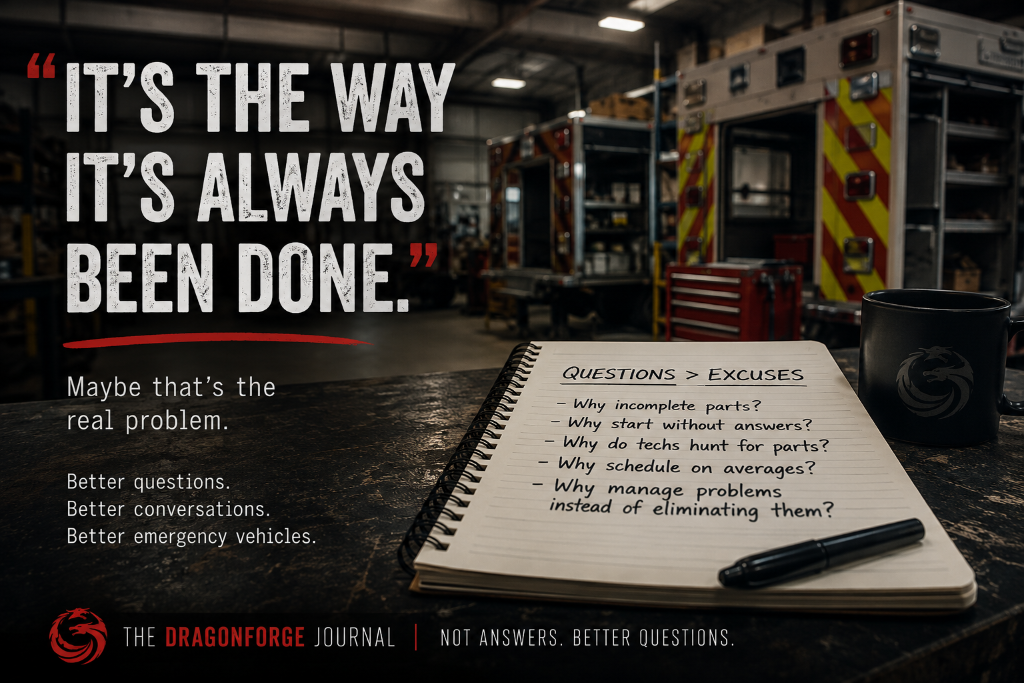
It's the Way It's Always Been Done
"It's the way it's always been done."
How many times have we said that? How many times have we heard it?
We start builds without all the parts on hand. Technicians walk across the building multiple times a day to find what they need. Someone asks an engineering question after production has already started. A bracket doesn't fit, so we make it work. Engineering changes come in after we're halfway through the build. Schedules slip because something wasn't ready. We guess at how much wire and connectors a job will need instead of measuring. Customers are frustrated with lead times. Owners are frustrated with employees. Employees are frustrated with the system.
It's the way it's always been done.
For years, I believed hard work could solve everything. Like many business owners, I worked nights and weekends. I did whatever it took. When the company was small, that was enough. The business depended on my effort, and I gave it everything I had.
But eventually, the business grew.
Employees were hired. Schedules stretched months into the future. The business no longer depended on one person's effort—it depended on systems. And those systems were built on assumptions we never questioned.
Then came COVID. If you're in this industry, you know what happened. Parts shortages. Scheduling chaos. Customer frustration. Constant changes. Everyone had legitimate reasons for why projects were delayed. Supply chains were broken. Lead times exploded. Nothing was predictable.
But legitimate reasons are not the same thing as solutions.
I was explaining all of this to someone I greatly respected—listing all the challenges, all the obstacles, all the things outside our control. That person asked one simple question:
"Why are you allowing the problems to exist in the first place?"
I didn't even understand the question at first. Of course those problems existed. Every upfitter dealt with them. That's just the industry. It's the way it's always been done.
But the question never left me.
Since then, I've begun asking different questions:
Why are technicians walking all over the building?
Why do engineering questions happen after production starts?
Why do we begin work without everything we need?
Why are schedules based on averages instead of actual work?
Why do we create systems to manage problems instead of eliminating the problems themselves?
This article intentionally provides no solutions. The purpose is simply to encourage people to question assumptions.
Here's what I've learned: I no longer assume I'm right. Instead, I assume there is probably a better question waiting to be asked. Sometimes that question changes nothing. Sometimes it changes everything.
That is the mindset behind this journal.
Future entries will explore topics like lead times, scheduling, technician shortages, planning, manufacturing, rework, communication, and continuous improvement. These articles are not about proving I'm right. They are about asking better questions.
I'm not writing this journal because I think I have all the answers. I'm writing it because I think our industry deserves better questions.
About the Author
Patrick Jiles is the Founder of Recreational Electrical, an emergency vehicle upfitter based in Colorado.
His experience in the emergency vehicle industry spans nearly three decades. Fresh out of college, he helped build fire apparatus before serving as a volunteer firefighter, where he learned to drive the trucks, operate the pumps, respond to EMS calls, and—most importantly—experience emergency vehicles from the user's perspective.
That perspective shaped the rest of his career.
Frustrated by inconsistent workmanship and the acceptance of "good enough," Patrick founded Recreational Electrical with the goal of building cleaner, more reliable emergency vehicles.
Over the years, his focus expanded beyond craftsmanship to something larger: questioning long-held assumptions about how emergency vehicles are engineered, planned, manufactured, and supported.
He doesn't claim to have all the answers.
Many of the ideas in this journal began when he realized some of his own assumptions were wrong.
His goal is simple:
Ask better questions.
Question to Think About
What's one problem that everyone accepts as "just the way it is"—and what would happen if you asked why it exists in the first place?